

A celebration of the
Pelicans, Pronghorn, Bison, & Burrowing Owls
Antelope Island, Davis County


Located at the newly renovated Visitors Center at Antelope Island State Park, this mural highlights four species that define one of Utah’s most iconic and complex landscapes: American bison, burrowing owls, pronghorn and American white pelicans. Designed and installed as part of the Visitor’s Center expansion construction project completed in 2026, this mural adorns the education entrance where field trips of students will unload and enter the building.

Antelope Island sits in the Great Salt Lake and supports a mix of grassland, shoreline and desert habitat, creating one of the most accessible wildlife viewing areas in the West. While it feels wild because of the lack of development, the island is also highly managed within a system that requires ongoing intervention to stay balanced. The island provides unparalleled opportunities for memorable face-to-face wildlife encounters. But remember, don’t get too close to the Bison!
Wikimedia Commons: JustinMorris
This project was made possible through key partnerships.
This project was made possible with partnership from Antelope Island State Park, Antelope Island Friends, and Discover Davis. This mural is part of the statewide Wildlife Walls project to install monumental murals in every county of Utah. A QR code is installed on each mural to educate visitors about the species and provide recommendations for nearby first-hand wildlife encounters.


American Bison

Courtesy of UDWR
The American bison is the most visible and iconic species on Antelope Island. Once numbering in the tens of millions across North America, bison were nearly driven to extinction in the 1800s. The Antelope Island herd began in 1893 with 12 animals and has since become one of the largest publicly managed bison herds in the country.
Today, between 500 and 700 bison roam the island. While they appear wild, they are carefully managed to prevent overgrazing and ecological damage. Because there are no natural predators on the island, the population would grow rapidly without intervention, so annual roundups are used to monitor health, collect data and remove excess animals.
-
American bison are the largest mammals in North America. Millions of bison once inhabited Utah’s grasslands, until they were hunted to near extinction in the 1800s.
-
Bison can weigh up to 2,000 pounds and run up to 35 miles per hour despite their size.
-
The Antelope Island herd is genetically important and used to support conservation herds across North America.
-
Annual roundups and auctions are necessary to maintain a sustainable population within the island’s carrying capacity.
Bison Safety
Bison are often perceived as slow or passive, but they are unpredictable and capable of serious injury. Visitors should keep a large distance, stay in vehicles and avoid approaching bison for photos. Follow these bison safety guidelines to stay safe.
Burrowing Owls

Courtesy of UDWR
Unlike most owls, burrowing owls live and nest underground, often using burrows created by mammals. On the island, they can sometimes be seen standing upright near burrow entrances in open grasslands. The hills around the Antelope Island Visitors Center are burrowing owl habitat, and they can sometimes be seen nearby.
Burrowing owls are declining across parts of their range due to habitat loss, development and the disappearance of the open landscapes they depend on. Antelope Island provides a relatively protected place where visitors can observe them without traveling far from the Wasatch Front.
Burrowing owls on Antelope Island are monitored by HawkWatch International, which bands individuals with a large colored band marked with one letter and one or two numbers, which can often be seen with binoculars or a camera. The public is encouraged to report any sightings online to help contribute to long-term studies that track movements and survival over time.
Burrowing owls typically migrate in the winter, but some individuals have begun staying in Utah year-round, likely due to milder winters. While warming temperatures may benefit overwinter survival, the long-term effects of hotter summers and changing ecosystems remain uncertain.
One of the most direct ways people can help burrowing owls and other raptors is by reducing the use of insecticides and rodenticides, which impact their food sources and can poison birds indirectly. Keeping dogs on leash and cats indoors also helps reduce predation pressure in areas where they live.
-
Burrowing owls are active during the day, making them easier to observe than many other owl species.
-
They rely on open landscapes with low vegetation and existing burrows for nesting. They do not dig their own holes.
-
Burrowing owls often line the entrance of their burrows with animal dung, which helps attract insects they feed on, essentially turning their burrow into a built-in hunting trap.
Pronghorn

Courtesy of UDWR
Antelope Island is named for the native pronghorn, which are less commonly seen here now than the bison. Also, these animals are not actually true antelopes. Pronghorn are found only in North America and are the last surviving member of their evolutionary family.
Pronghorn are built for speed and endurance, adapted to open landscapes where they rely on visibility and movement to survive. Across the West, many populations undertake seasonal migrations that can span dozens to over a hundred miles, moving between summer and winter ranges in search of food and favorable conditions. Because of this, pronghorn depend on large, connected landscapes. The famed Path of the Pronghorns in Wyoming is a large-scale example of this.
Barriers like roads, fencing, housing and development can disrupt these movements. Unlike deer or elk, pronghorn rarely jump fences and instead try to crawl under them, making even low barriers a big obstacle. Habitat fragmentation is one of the biggest long-term threats to the species.
Protecting pronghorn means protecting open space. Supporting land conservation efforts, wildlife corridor projects and responsible land use planning helps them continue to move across the landscapes they depend on. Visitors can also help by staying on designated routes, avoiding off-road travel in sensitive areas and respecting seasonal closures that protect wildlife movement and habitat.
-
Pronghorns are the fastest land animals in North America and can run more than 50 miles per hour.
-
They can sustain high speeds longer than a cheetah, making them one of the great endurance runners of the animal world.
-
Both males and females have horns, and pronghorn shed the outer sheath of their horns each year.
American White Pelican
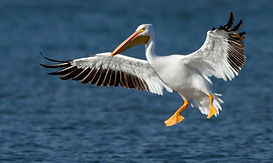
By Manjith Kainickara - originally posted to Flickr as American White Pelican, CC BY-SA 2.0,
American white pelicans are one of the most beautiful species in the Great Salt Lake ecosystem. With wingspans that can reach up to 9 feet, they rely on shallow water and productive wetlands to breed and feed.
Pelicans in the Great Salt Lake region are closely tied to water levels and island nesting habitat. They depend on remote islands to protect their colonies from predators. Gunnison Island in the lake’s north arm has historically been home to one of the largest breeding colonies in North America, at times hosting up to 20,000 birds. In 2023 and 2024, declining water levels created land bridges to Gunnison Island that coyotes and other predators used to reach nesting sites, forcing pelicans to abandon their nests. In response, many birds shifted to nesting on Hat Island, a site they had not used since the 1940s.
American white pelicans are considered an indicator species for the health of the Great Salt Lake. Their success or failure reflects broader environmental changes like drought levels and shifting habitat conditions.
One of the most direct ways to support pelicans is by supporting efforts to protect and restore the water levels of the Great Salt Lake. Water conservation, awareness of declining lake levels, education on why the lake is dropping and support for policies that maintain inflows all help preserve critical habitat. Learn more about protecting the Great Salt Lake here.
When visiting, please keep a distance from nesting areas and avoid disturbance during the breeding season to help colonies remain stable.
-
American white pelicans feed cooperatively, often working in groups to herd fish into shallow water.
-
They depend on isolated nesting sites that protect eggs and chicks from predators.
-
Changes in water levels can directly affect nesting success, predator access and colony stability.
Antelope Island mural
A window into the wild beauty of Utah's inland sea
From the Artist
In 2022, the vision for wildlife walls began with a cutthroat trout mural in Salt Lake City. The very first wall that came to mind when I started talking with local writer Brett Prettyman about painting giant wildlife murals across the state was the Antelope Island State Park Visitors Center. Its brutalist architecture, with its giant concrete walls, called for some decoration to celebrate the local species.
Since 2023, I’ve worked with three park managers - Jeremy Shaw, then Wendy Wilson, and Doranne Pittz- to realize this project in June 2026. The long lead time was due to visitor center renovations, which began shortly after our first visit. Construction took longer with the addition of the IMAX theater to the visitor center plans.
Multiple mockups were created at different stages of construction, but ultimately we decided to focus the murals on the education (original) entrance to the visitor center. Two adjacent facets were mocked up highlighting a variety of local species. Ultimately, we decided to feature the American Bison, Burrowing Owls, White Pelicans, and of course, the Pronghorn Antelope.
We received $10k in funding from Discover Davis in 2025, with a May 1st deadline. With the construction schedule, this was going to be tight and would require me to endure the worst of the bug season. I was nervous about these conditions as I prepared, but then I was blessed with construction delays that pushed my start date to June 1. With this delay, I experienced almost no bugs at all because recent high temps had taken care of them.
In reality, the installation process was such a gift. The building had only just been handed back over to State Parks, and there were very few people around when I started working. However, the critters were all over the place! Bison, pronghorn, burrowing owls, and pelicans all within sight of the wall.
The first night, I rolled in around 4pm and masked and spray-primed the surfaces. I was able to get in some background spray on the pelicans and burrowing owls. After dark, I projected the lines for those birds, then drove my box truck to Bridger Bay Campground near the visitors center and slept in the back. The next day, I started painting those birds and laid down background color for the bison and pronghorn. I was lucky to have UDWR staffer Crystal Ross and Jake Serago volunteer to help draw the bison and pronghorn lines on the wall. It felt like we were carrying on some ancient tradition of translating our awe of these creatures into wall art.


I projected that night and was there till midnight, so I didn’t move the truck, just slept in the back and woke up with the sun to paint. A day each on the pronghorn and the bison. Gotta shout out Crystal Ross who came out to help paint and bring provisions a few times; it was a gift to spend time learning about and marveling at that special place with someone who knows and loves it as Crystal does. The sparrows were flying around all the time, and I had to keep kicking them out of my truck before they started building nests in there. On the day of spraying the background, Kema Hanks helped me tape off the critters and prep for spray. I used 7 colors for the day-to-night gradient that stretches south to north. After that, Connor Weight came out and helped me hand-paint a couple hundred stars.
The location, the architecture, the geography, and the forest-fire-fed sunsets all contributed to a surreal install process. The sunsets were mind-bogglingly beautiful. After all day painting, I spent quite a few nights enjoying the color gradients morph across the sky. I shared one particularly magical moment when a little bunny stopped in front of me on the deck. It was perfectly silhouetted against the fieriest unreal sunset ever. I think that will need to be a painting someday because I will never forget that encounter. C.P 7/16/26


Celebrating Utah's wildlife with big art and wildlife encounters across the state on the Wildlife Walls Mural Trail.
The Wildlife Walls Mural Trail links 14 wildlife murals and 100+ wildlife viewing areas.
The Mural Trail was created to inspire people to get outside; Travel the Mural Trail across Utah’s spectacular landscape to visit epic murals AND enjoy diverse wildlife encounters of your own.

Hit the Mural Trail, share on social media, and tag us & hashtag: #wildlifewalls
ZOOM IN!
to 100+ wildlife viewing areas across Utah
Wildlife Walls Mural Trail Map
Where to see Pelicans, Pronghorn, Bison & Burrowing Owls
Pelicans
-
Great Salt Lake shoreline near Antelope Island: Best viewed during warmer months along the causeway and shoreline.
-
Farmington Bay Waterfowl Management Area: A seasonal viewing area for waterfowl and shorebirds.
-
Bear River Migratory Bird Refuge: One of the best large-scale birding sites in northern Utah and a major stopover for migratory birds.
Pronghorn
-
Antelope Island grasslands: Pronghorn may be seen in open areas, often at a distance. Bring binoculars.
-
Western Utah desert basins: Broad desert and sagebrush landscapes in Utah can offer more consistent pronghorn viewing opportunities.
-
Antelope Island State Park: Bison are commonly seen along roads, trails and open grasslands.
-
Fielding Garr Ranch Area: One of the most reliable areas for sightings due to water and grazing conditions.
-
Frary Peak Road: Scenic drive with frequent roadside encounters.
Burrowing Owls
-
Antelope Island Visitor Center Area: One of the most accessible viewing areas. Look for owls standing near burrow entrances.
-
Open flats and grasslands across the island: Scan low vegetation and open ground, especially during spring and summer.
If you encounter any bison, it is very important to give them space, stay calm, keep any dogs leashed and under control, and back away slowly.
Wildlife Etiquette: Always observe from a distance, stay on marked trails, and never feed wild animals. Do not approach animals for photos. Definitely don’t put them in your car!
Plan your trip
Travel Amenities
Accommodations:
-
Bathrooms and Water: Available at the Antelope Island visitor center and main day-use areas. Some campgrounds have limited facilities.
-
Primitive camping is available on the island, with additional lodging options in Syracuse, Layton and Salt Lake City.
Fuel and Supplies:
-
There are no major services on the island. Visitors should fuel up, bring food and carry plenty of water before crossing the causeway.
Best Time to Visit:
-
Spring and fall offer the best combination of wildlife activity and moderate temperatures. Bird migration also peaks during these seasons.
What to Bring:
-
Binoculars, water, sun protection, sturdy footwear and layers. Conditions can be hot, dry, windy and exposed.
While You’re Here, Consider Exploring
-
Fielding Garr Ranch: A historic site tied to the island’s ranching history and bison management story.
-
Frary Peak Trail: A challenging hike with great views of the Great Salt Lake and surrounding mountains.
-
Causeway Drive: A scenic access road with opportunities to see waterbirds, shorebirds and changing lake conditions.
Other Nearby Wildlife Opportunities:
-
Raptors @ Great Salt Lake wetlands: Golden eagles, northern harriers, kestrels and red-tailed hawks are commonly seen hunting across open terrain.
-
Shorebirds @ Bear River Migratory Bird Refuge: One of the most important bird migration stopovers in the region home to American avocets, black-necked stilts, sandpipers and phalaropes during peak migration seasons.
-
Great blue herons & wetland birds @ Eccles Wildlife Education Center: Great blue heron rookery, along with black-crowned night herons, egrets, ducks, and other marsh species.
-
Raptors, owls & songbirds @ Ogden Nature Center: Find kestrels, great horned owls, Cooper’s hawks, woodpeckers and a variety of songbirds.
-
Mule deer & upland wildlife @ Farmington Canyon: Drive up Farmington Canyon for the chance to see mule deer, wild turkeys, occasional moose and seasonal raptors and songbirds.